Briefing · June 19, 2026
Your AI Skills Inventory Is a Fiction — And You're Making Decisions Based on It
Self-reported AI proficiency data is driving budget allocations, role redesigns, and board conversations. The verified reality is significantly worse — and the gap is a measurement problem, not a training one.
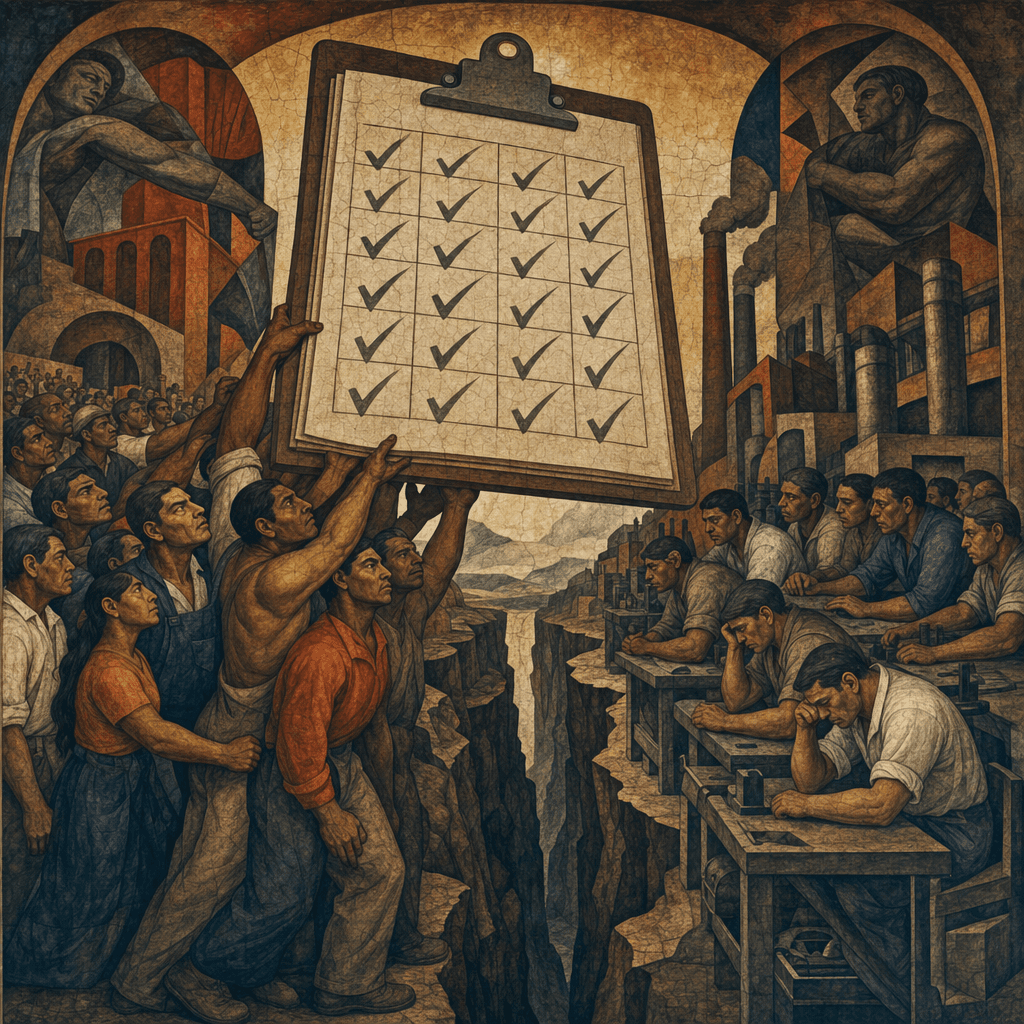
Most AI upskilling programs are built on a foundation that doesn't exist. Organizations survey employees, collect self-assessments of AI proficiency, and then design training curricula against those numbers. It feels rigorous. It is not. New benchmark data makes the problem impossible to ignore: verified AI skills lag dramatically behind what employees self-report, meaning every workforce readiness dashboard built on survey data is, to some degree, a work of organizational fiction.
The verified gap between self-reported and actual AI competence is, according to HR Executive (2025-06-10), large enough to constitute a strategic risk — HR leaders are making budget allocations, role redesigns, and promotion decisions based on a skill set that hasn't been validated. The Dunning-Kruger dynamic at the individual level is well-documented; what's less appreciated is how organizations systematize that overconfidence by treating self-report as ground truth.
The downstream consequences aren't abstract. If your AI-adjacent roles are staffed based on survey-indicated proficiency, and the actual capability floor is significantly lower, you haven't closed a skills gap — you've papered over it. Training investments land in the wrong places. High-performers who genuinely have AI skills are underidentified. And when the work product doesn't meet expectations, the diagnosis is usually "change management failure" rather than "we never knew what our people could actually do."
The same measurement failure shows up in a different form when organizations deploy new systems and then wonder why nothing changes. HR Dive (2025-05-15) reports that HR teams continue to rely on manual workarounds even after implementing new HCM platforms — a pattern consistent with a broader finding that poor implementation leaves workers not actually using the tools they were given. This is what happens when capability assumptions drive deployment timelines. The system is live; the skill to use it isn't.
A useful counterpoint comes from McKinsey's analysis of AI workflow redesign (2024-11-12): the organizations that capture meaningful value from AI are not those that add tools to existing processes, but those that redesign the workflow itself around validated capability. The implication is direct — the organizations seeing real returns from AI aren't the ones with the most training hours logged; they're the ones that knew what their people could actually do before they rebuilt around it. If your current deployment strategy skipped that step, you didn't implement AI. You installed it.
There is a structural response to this problem that deserves more than a casual mention. MIT Sloan Management Review's guide to its recent research agenda (2025-05-01) identifies what researchers call the "AI spine" — a coordinated cross-functional internal structure that draws on domain expertise and user innovation rather than relying on individual self-assessment. The logic is unambiguous: if you can't trust individual self-assessment, you need an organizational layer that can observe, validate, and distribute capability in real time. The companies building that infrastructure now are making a bet that verified skill architecture will compound in value faster than any training catalog.
The question you should face as a senior HR leader isn't about tools or training vendors. It's about accountability. If your current workforce AI strategy is built on survey data, what would it cost to replace a portion of that data with verified assessments — not to punish employees who overestimated themselves, which is a predictable human behavior, but to actually know what you're working with? The answer is almost certainly less than the cost of another year of misallocated training spend.
Consider also what happens to your credibility when the board asks about AI readiness. If the honest answer is "we have self-reported proficiency data across 80% of the workforce," that is a different answer than "we have verified competency baselines across critical AI-adjacent roles." One is an activity metric. The other is an input to a real workforce strategy. Boards increasingly know the difference — and they are starting to ask which one they're looking at.
The gap between self-reported and verified AI skills isn't a training problem — it's a measurement problem masquerading as a training problem. Fix the measurement, and you'll find the training problem is smaller, more specific, and far more solvable than the survey data suggested. The organizations that figure this out first won't just have better AI adoption numbers; they'll have a cleaner read on every capability investment that follows.
Created with AI assistance. Editorial oversight: Juergen Ritzek. See our AI disclosure.