Briefing · July 6, 2026
What Kevin Schmitt Just Got Right About Scaling AI Inside Organizations
MIT Sloan's Kevin Schmitt has a name for the structural fix AI adoption desperately needs — and it's not another center of excellence.
Kevin Schmitt is not a pundit making predictions about AI. He is a researcher who spent three years inside 23 companies watching what actually happens when organizations try to turn generative AI pilots into durable value — and what he found should reframe how you're thinking about your own AI investment this quarter.
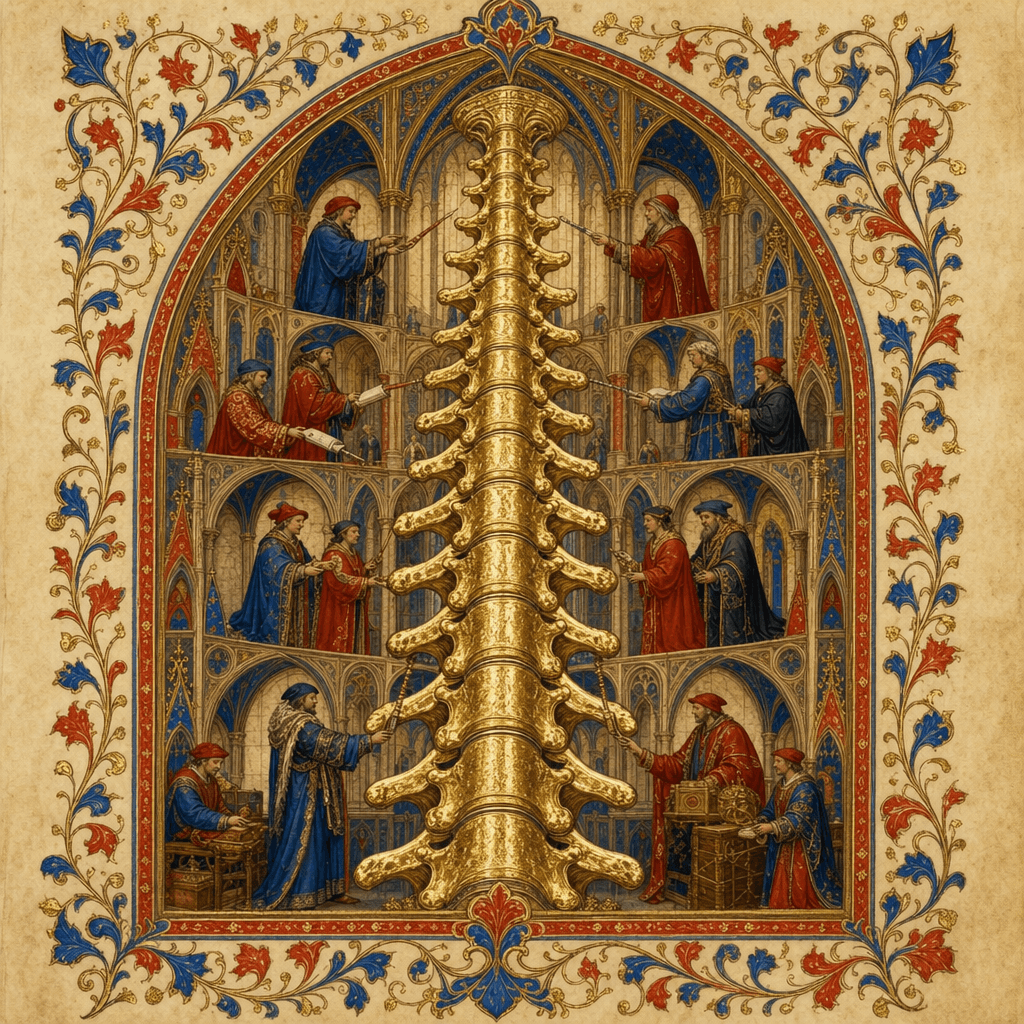
Schmitt, along with co-authors Gregory Vial and Ivo Blohm, published their findings in MIT Sloan Management Review's Summer 2026 issue. The research draws on a consortium of Swiss firms spanning retail banking, investment banking, health insurance, medical coding, energy, law, and laboratory instrument manufacturing — a spread wide enough to make the patterns meaningful rather than sector-specific. The headline finding is both simple and structurally inconvenient: organizations that successfully scale GenAI are not the ones with the best models or the biggest budgets. They are the ones that built what the researchers call an "AI spine" — a coordinated cross-functional structure that connects domain expertise with user innovation.
The AI spine is not a rebranded center of excellence, and that distinction matters. Centers of excellence tend to centralize expertise and issue guidance downward. The AI spine, as Schmitt's team describes it, is designed to move in both directions — capturing what frontline users are actually doing with AI tools and routing that signal back into governance and prioritization. It is less a hierarchy and more a connective tissue. If your organization has an AI task force that meets monthly and publishes a policy deck, you do not have a spine. You have a memo.
Why does this matter right now, this week? Because the pressure to show AI ROI is intensifying at exactly the moment when structural gaps are becoming impossible to ignore. Challenger, Gray & Christmas data (2026) shows tech sector job cuts jumped 83% year-over-year in the first half of 2026, with AI disruption cited as a primary driver. Boards are reading those numbers and asking hard questions about whether their own AI spend is building capability or just burning cash. Schmitt's framework gives you a structural answer rather than a narrative one.
There is also a shadow problem Schmitt's work implicitly addresses. HR Dive (2026) reports that the "bring your own AI" trend is accelerating, with employees sourcing and deploying personal AI tools outside any organizational oversight — creating accuracy and compliance exposure that most HR and legal teams have not yet priced in. An AI spine, by design, creates the feedback loops that surface this shadow adoption before it becomes a liability. Without that structure, you are not governing AI use; you are merely hoping you find out about the problems before a regulator does.
The implication for HR leaders specifically is pointed. Schmitt's research finds that domain expertise is not optional decoration in an AI spine — it is load-bearing. That means the people who understand how work actually gets done, who hold the tacit knowledge about what a good outcome looks like in a given function, are not being replaced by AI; they are the infrastructure through which AI becomes trustworthy. If your workforce planning conversation is still framed as "AI versus headcount," you are optimizing for the wrong variable. The question is not how many people AI replaces. It is whether you have retained the domain knowledge that makes AI outputs auditable.
Schmitt's team also documented a governance companion to the spine concept in a related MIT Sloan piece on adaptive AI governance (2026), drawing on interviews at Microsoft, Barclays, Nasdaq, Lloyds Bank, and others. The consistent finding across organizations: static governance frameworks collapse under the pace of AI development. The organizations that stayed ahead built governance that updated continuously — not annually in a policy review cycle.
The actionable takeaway from Schmitt's body of work is unglamorous but precise: map your current AI initiatives and identify whether domain experts have a formal, recurring channel to influence AI prioritization and flag failures. If that channel doesn't exist, you don't have an AI strategy — you have a collection of AI experiments with no immune system.
Schmitt and his co-authors have done the empirical work that most AI commentary skips. Three years, 23 companies, granular enough to distinguish structure from noise. That is worth your attention, and worth a conversation with your CHRO about what your organization's connective tissue actually looks like today.
Created with AI assistance. Editorial oversight: Juergen Ritzek. See our AI disclosure.