Briefing · October 24, 2026
HR Is Fracturing Into Two Castes — and the Gap Is Widening Fast
AI is splitting HR into data-fluent strategists and administrative remnants — and most teams aren't ready for what that means.
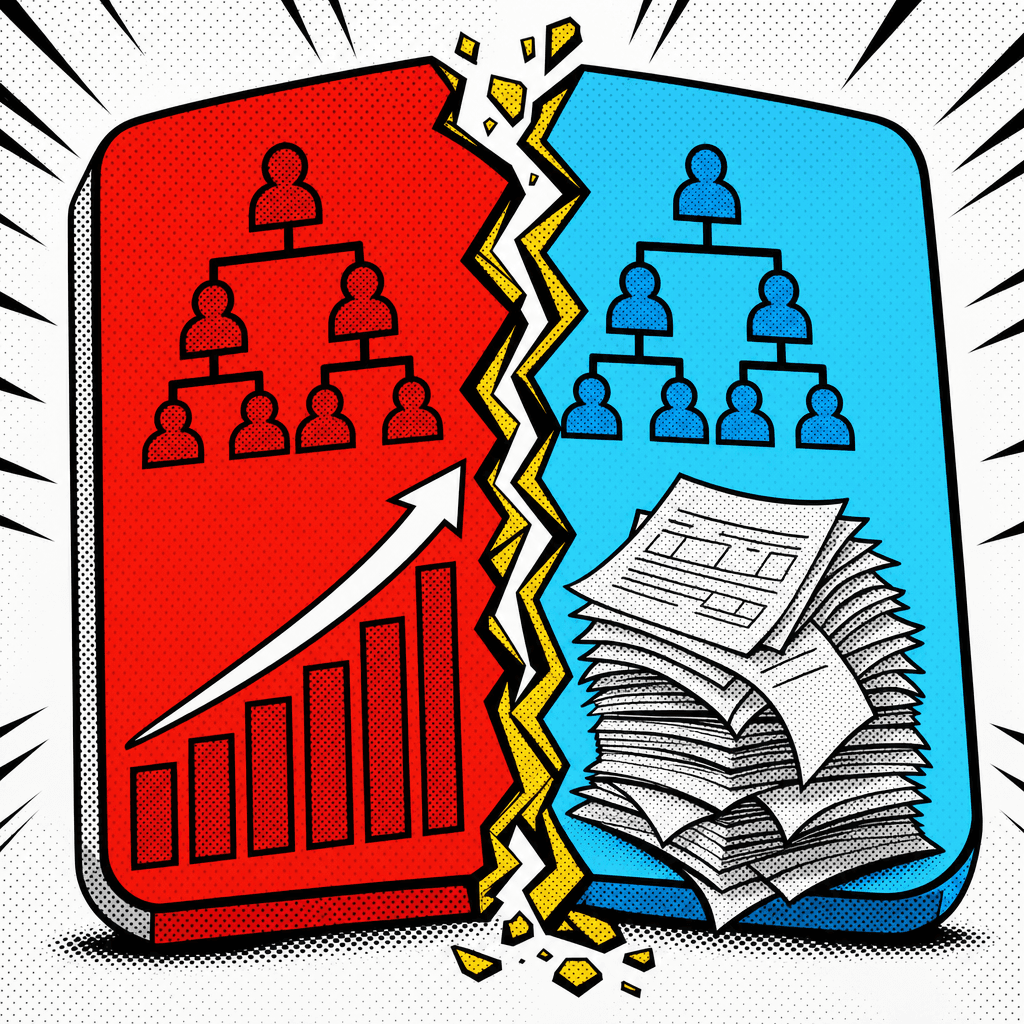
The assumption that HR transformation is a spectrum — everyone moving forward at different speeds — is wrong. According to workforce intelligence firm Draup, artificial intelligence is cleaving the HR profession into two distinct archetypes: analytically-driven strategists and administrative generalists whose core skills are actively declining in market value, with every role from HR specialist to chief human resources officer (CHRO) now requiring data analytics competency as a baseline, not a differentiator, HR Dive (2025-07-22).
That one sentence is worth pausing on. Not "eventually required." Not "preferred." Baseline. The floor has moved, and a significant portion of your HR function is standing below it.
What does "HR archetype splitting" actually mean?
The plain-language version: AI-driven automation is eliminating the transactional layer of HR work — benefits processing, scheduling, compliance tracking, routine reporting — faster than organizations are retraining the people who do it. What remains is a bifurcated profession: one tier that can translate people data into business strategy, and another that cannot. The gap between them is not a skills gap in the traditional sense. It is a structural gap — a difference in what the job is, not merely what tools it uses. Draup's analysis HR Dive (2025-07-22) shows traditional administrative skills are not just deprioritized; they are declining in demand at the role level. That is a different problem than upskilling. It is a workforce design problem.
Is your CHRO building the right HR team for an AI-native organization?
Here is where the CEOs-and-AI data adds a sharp edge. More than 6 in 10 U.S. CEOs said in 2025 that they were confident their firms were moving at the right pace or ahead of the curve on AI — yet the same KPMG report found that those same leaders are not yet seeing transformational change from AI in practice HR Dive (2025-07-23). Confidence without outcomes is a dangerous place to park strategy. The optimism gap is precisely where bad HR workforce planning decisions get made: leadership believes the organization is adapting, while the function beneath them is quietly bifurcating.
The implication is uncomfortable. If your HR team is structured around the administrative archetype — and many are, because that is how HR grew historically — you are not running behind on transformation. You are running a function that is becoming structurally obsolete at its core. The question is not whether to restructure; it is whether you will do it deliberately or be forced into it.
This matters beyond HR as a department. The Draup analysis signals something broader: AI is not evenly distributing its pressure across an organization's workforce. It is concentrating disruption in functions where work has historically been process-heavy and documentation-intensive. HR, legal, finance, and compliance all share this profile. If it is happening to HR first, it is a preview of what operational leaders will face in adjacent functions within 18 to 36 months.
What should organizations actually do with this finding?
The framing most CHROs reach for — "we need to upskill our HR team in data analytics" — is the right answer to the wrong question. Sending HR business partners to a Power BI course does not close a structural gap. The real question is whether your HR operating model was designed around tasks that AI now performs better, cheaper, and faster than people. If the answer is yes, training is a palliative, not a fix.
The organizations that will come out of this with a functional HR capability are those treating this like a workforce redesign problem: auditing which HR roles are predominantly administrative versus analytical, mapping those roles against Draup's archetype framework, and making hard decisions about what the function looks like in three years — not six months. Forward-deployed AI capabilities, where analytical tools are embedded directly into the workflow of HR business partners rather than sitting in a separate analytics team, are emerging as one model worth watching, as McKinsey has noted in adjacent contexts McKinsey (2025).
The hardest board conversation is not about AI ROI. It is about telling your leadership team that the HR function they approved headcount for last year is being redesigned around a fundamentally different set of skills — and that the people currently in those seats may not be the people who fill them in three years. If you are not having that conversation yet, the archetype split Draup has identified is already making it for you.
Created with AI assistance. Editorial oversight: Juergen Ritzek. See our AI disclosure.