Briefing · October 6, 2026
California's AI Firing Ban Is the Employment Law Signal Every CHRO Should Take Seriously
California just banned solo-AI terminations — and the ripple effects will reach every boardroom that thinks algorithmic HR is a compliance-free zone.
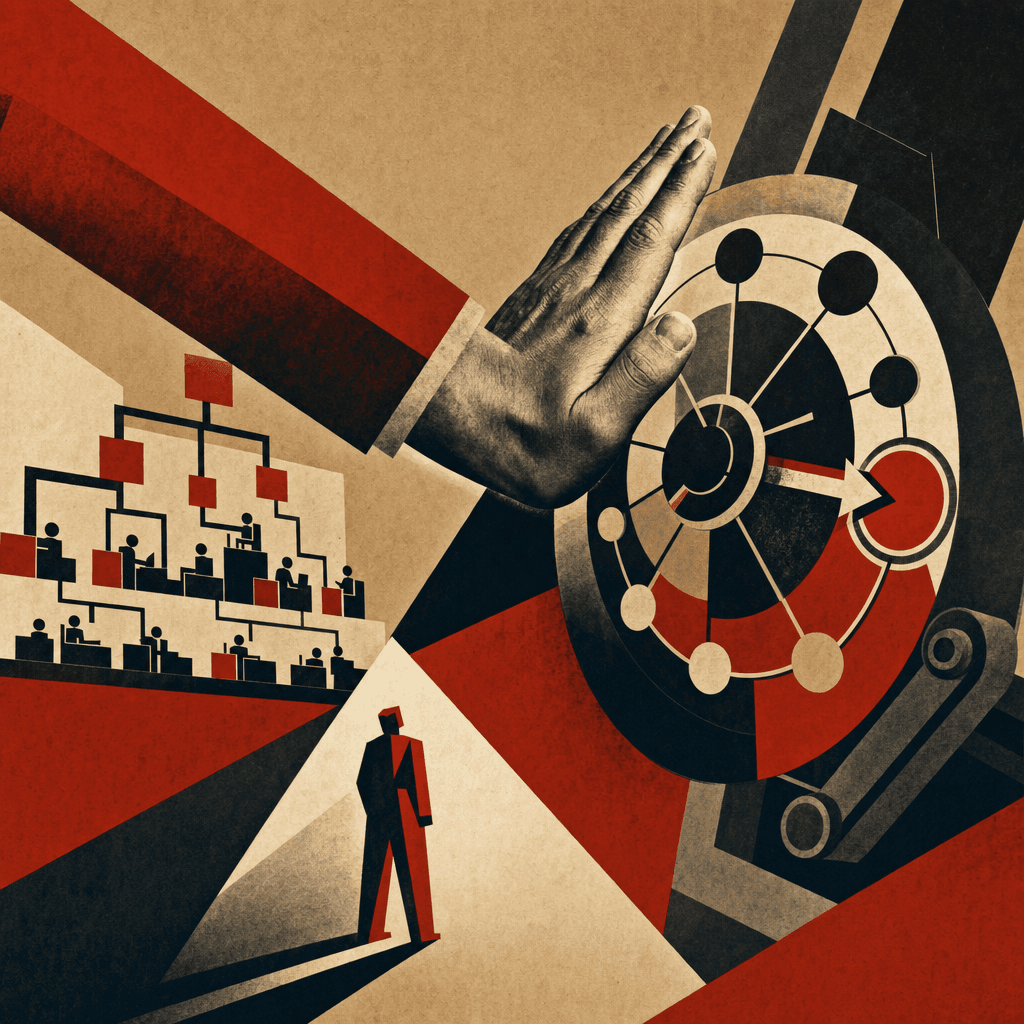
California has a way of writing the first draft of national employment law. The state's new legislation — signed as part of what Governor Gavin Newsom called a "nation-leading framework" for worker and consumer protection — prohibits employers from using artificial intelligence (AI) as the sole basis for dismissing or disciplining employees, establishing for the first time a legal floor on human judgment in termination decisions. That single sentence is the story: California law now requires that a human being be meaningfully involved in any AI-assisted decision to fire or discipline a worker, making fully automated terminations illegal within state borders. The question isn't whether your organization operates in California — it's whether you're building HR infrastructure that will be legally indefensible everywhere within three years.
Why Did California Pass a Law Banning AI-Only Firings?
The short answer is that the tools outran the guardrails. AI systems used in workforce management — productivity scoring engines, attendance-monitoring platforms, performance-rating algorithms — can now generate termination recommendations faster than any HR team can review them. Personnel Today reported in 2025 that California's ban covers both dismissal and discipline, meaning the law applies well before the termination stage. This is not a narrow carve-out for egregious cases; it's a structural requirement that human accountability must sit above the machine at every consequential decision node.
The plain-language principle at stake here is what legal scholars call "meaningful human review" — the idea that automated systems can inform a decision but cannot own it. Meaningful human review means that a qualified person must independently assess the AI's recommendation against the specific facts of the individual case, not simply rubber-stamp a score. Once that standard is codified in statute, every employer who has built a workflow where HR clicks "approve" on an algorithm's output without genuine deliberation is exposed.
How Does California's AI Law Fit the Broader Regulatory Picture?
The California legislation does not exist in isolation. HR Dive (2025) reported that Newsom signed multiple worker-protection AI bills simultaneously, signaling a coordinated legislative strategy rather than a one-off reaction. Read alongside two recent Equal Employment Opportunity Commission (EEOC) enforcement actions, the regulatory direction becomes unmistakable.
In one case, the EEOC moved to enforce a subpoena against Hyundai over an alleged refusal to hire non-Korean applicants, with national origin discrimination listed as a prominent part of the commission's current regulatory agenda. In a separate action, a firm settled an EEOC charge after allegedly allowing Indian staff to work remotely while denying the same flexibility to U.S.-based employees — with the EEOC explicitly stating that remote-work determinations cannot be based on race or national origin. Neither case involves AI directly, but both illustrate the same regulatory posture: agencies are actively probing the criteria embedded in workforce decisions, whether those criteria live in a manager's head or in a machine-learning model's training data.
The convergence matters because AI models trained on historical HR data inherit historical biases. An algorithm that scores employees for performance based on patterns from a workforce that was not equitably composed will reproduce those inequities at scale — and faster than any compliance team can catch. When the EEOC is already pursuing subpoena enforcement over national-origin bias in hiring, the risk that it turns its attention to discriminatory outputs from opaque algorithmic systems is not hypothetical.
What Should Executives Actually Do With This?
The temptation is to treat California's law as a documentation problem — add a human sign-off box to the workflow and move on. That instinct will be expensive. The law's intent, and almost certainly its enforcement trajectory, targets substantive human review, not performative approval. If your AI system flags 200 performance-improvement-plan candidates per quarter and your HR team clears the queue in a morning, you do not have meaningful human review. You have liability wearing a checkbox.
The harder question for chief human resources officers (CHROs) and operations executives is what it costs to build review capacity that is genuinely proportionate to the volume of AI-generated recommendations. That is not a technology question. It is a headcount, training, and governance question — and the answer will not fit inside the budget line that was sold to the board when the AI platform was approved.
The ghost-job and fake-applicant crisis is already eroding trust between employers and candidates at the top of the funnel. If algorithmic terminations without genuine human accountability become the norm at the other end of the employment lifecycle, the reputational and legal exposure compounds. California drew the line. The board conversation you need to have is whether your organization is building toward that standard or running away from it.
Created with AI assistance. Editorial oversight: Juergen Ritzek. See our AI disclosure.